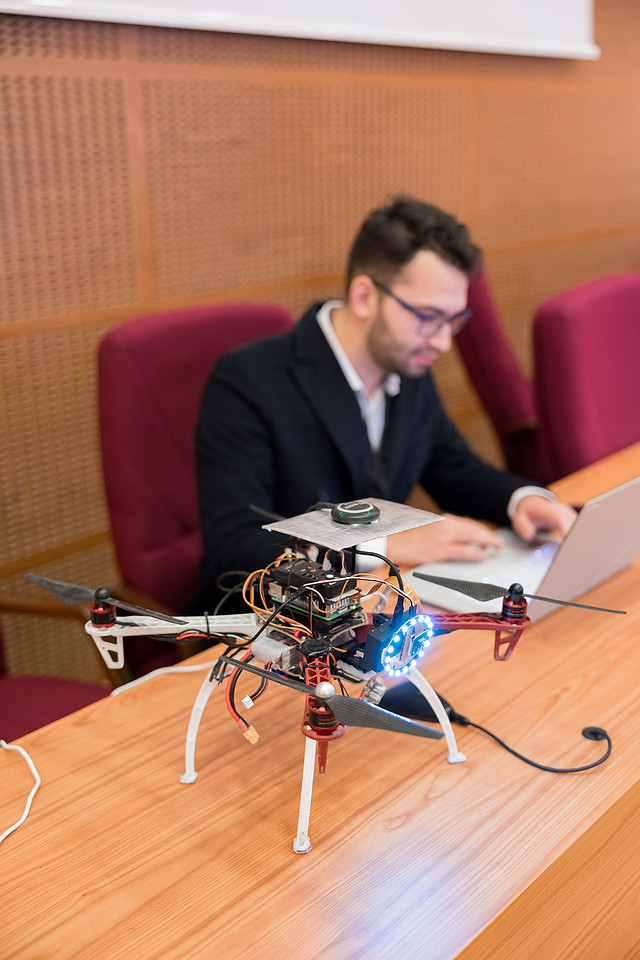
We are excited to announce a partnership with the Faculty of Automation and Computer Science at the Technical University of Cluj-Napoca. The first concrete piece of this collaboration is a student event — the Hasna Global × UTCN day on December 18 — focused on building practical AI agents using the open-source infrastructure we publish.
This is not a large, multi-year, many-school program. It is one university, one event, and one small research grant. We want to be clear about that because it would be easy to inflate the scale of what we are doing. Hasna is a small team, and we are doing this one step at a time. The honest description is: we found a university with strong faculty and motivated students in the city we are based in, and we are going to start there.
The event itself is simple in structure. A morning of talks and workshops, an afternoon build sprint in small teams, and evening Q&A. Students will use whatever tools they want, but most will probably reach for the open-source pieces we publish on our public page — connectors to common services, a memory system, a task manager, a browser automation layer. The prizes are modest: a cash award, hardware vouchers, and the chance to present winning projects to our engineering team.
What we care about is not the prize but the exposure. Students who participate get hands-on practice with the kind of agent-building that is quickly becoming a real job category. They also get direct feedback from working engineers, which is the most valuable thing any student can get. In return, we get to see motivated, early-career builders before anyone else does. If any of them end up wanting to work with us after graduation, that is a bonus.
The second piece of the partnership is a small seed grant for one research project at the university. The faculty proposed a handful of topics, and we picked the one most aligned with our own work: memory consolidation in long-running agents. That is a problem we are wrestling with internally — how do you keep an agent's memory coherent across weeks and months of use, without letting it accumulate noise? The UTCN group has a promising angle based on selective forgetting, and we are funding a PhD student to pursue it for a year. We will publish the results regardless of outcome.
Why this partnership, and why now? Two reasons. First, the talent pipeline for practical AI work is genuinely thin. Most universities are teaching AI in terms of training models from scratch, which is a small and expensive part of what anyone actually does with AI in production. The much bigger job — connecting AI to real tools, handling state, building reliable agent workflows — is not in any curriculum we have seen. If we want people with those skills in five years, somebody has to start teaching it now.
Second, we do not believe in gatekeeping. Our entire open-source stack is public. Our research is published openly. Contributing back to the educational system the same way seems like the natural next step. We have talked internally about expanding this to more schools once we see how the first one goes, but we are deliberately not pre-announcing anything. We would rather ship one thing well than announce five.
Logistics: the event happens in person at the UTCN campus in Cluj on December 18, with remote participation possible for students who cannot travel. It is open to enrolled students only — undergraduate or graduate, any program. Registration details are on the competitions page. A full recap with photos and results will follow after the event.
A word for the people who are skeptical that a small company can do anything meaningful for a university: we agree. One partnership, one event, one research grant is a drop in the bucket compared to what a large tech company can do. That is fine. The goal is not to be comprehensive. The goal is to do one thing well and see what it produces. If it works, we will do another. If it does not, we will try something else. In either case, we will be public about what we learned.
The people making this happen on the UTCN side are the dean's office and two faculty members who have been exceptionally generous with their time during the planning phase. We appreciate it. The first real deliverable is December 18. We will post results afterward, with honest numbers about turnout, what people built, and what we learned about running events of this kind.
If you are a student at UTCN and want to participate, the registration link is live on our competitions page. If you are faculty at another university in Romania or elsewhere and want to discuss something similar in the future, email [email protected]. We read everything and respond.