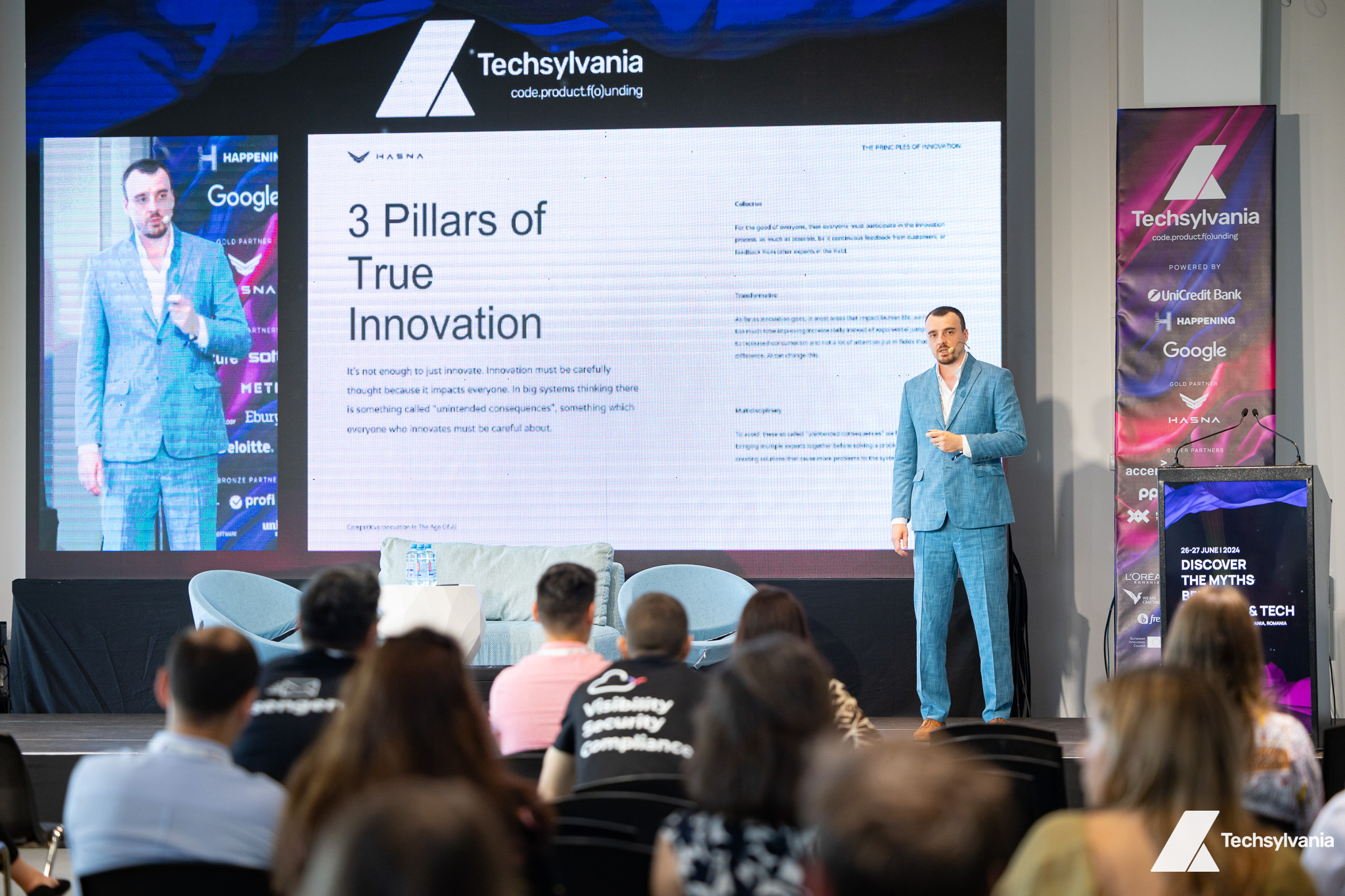
On the Impact Stage at Techsylvania 2025 in Cluj-Napoca, we spent thirty minutes making a simple case to a room of builders, founders, and engineers: AI is not coming for your job — it is coming for the parts of your job that nobody enjoys doing anyway. Done well, that is good for everyone involved.
The talk opened with the framing that every major technology shift of the last century has looked like displacement up close and augmentation from further away. Spreadsheets did not end accounting; they made accountants faster, moved the interesting work higher up the stack, and created more demand for financial analysis than the profession knew what to do with. Word processors did not end writing. Search engines did not end research. The pattern is consistent: tools that handle the mechanical parts of a job tend to expand the creative part, not shrink it.
We argued that AI agents are the next iteration of this pattern, but with a twist. Unlike earlier tools, agents can execute multi-step workflows across your tools — reading email, updating a database, writing code, running tests, posting to Slack — without a human clicking through each step. That is a qualitative shift. It means the unit of automation is no longer a single action but an entire workflow.
The second half of the talk walked through specific workflows we have replaced in our own company. We showed a pull request review agent that reads the diff, runs the tests, checks it against the design document, and leaves a first-pass review — saving our engineers about forty minutes a day each. We showed an inbox triage agent that sorts email, drafts replies, and flags the two or three messages that actually need a human to look at them. We showed a research agent that reads a topic, pulls relevant papers, and produces a two-page briefing that used to take a researcher a full afternoon to assemble.
None of this is science fiction. Every one of these agents is built on top of open-source infrastructure we publish for anyone to use: connectors that plug into any API, memory systems that keep context across sessions, task managers that coordinate multi-step work. They are not magic. They are software that anyone with a reasonable grasp of engineering can assemble.
The audience question that came up most was familiar: if these agents can do the mechanical work, what is left for humans? Our answer was the one that has always been right: the judgment. What to build. What not to build. Which customer to serve. Which tradeoff to accept. Which problem is worth the next quarter of your life. Agents do not have opinions about any of that. They execute on the decisions you hand them.
What shifts, in practice, is the shape of the day. Instead of spending eight hours on a mix of deep work and administrative overhead, you spend eight hours doing the thing only you can do, while the agents handle the rest in the background. The first month of this feels uncomfortable because the administrative overhead is also the thing that used to give you a sense of progress. It takes a few weeks to trust that the work is actually getting done, and then you start to notice you have more time to think.
We closed the talk with one caveat, which is that this transition is not automatic. Agents are most useful to people who already have strong judgment about their own work. If you are good at what you do, agents let you do more of it. If you are coasting, they will expose that quickly. The technology does not create value on its own. It amplifies whatever is already there.
One of the best questions came after the talk, from a designer who asked whether we worried about the moral weight of displacing certain kinds of work. The honest answer was yes — we do worry about it, and it is one of the reasons we ship as much of our infrastructure as open source. If this transition is going to happen, and we believe it is, it should happen in a way where the tools are accessible to everyone, not concentrated in a few large companies. That is the only way the upside spreads broadly enough to matter.
A few people came up afterward to ask how to get started with agents in their own companies. Our advice was the same we give to ourselves: pick one workflow you do every day that you do not enjoy, and see if you can automate ninety percent of it. Do not try to build a general-purpose assistant. Build one narrow tool that eliminates one annoyance, ship it to yourself, use it for a week, and then do it again. After ten of those, you will have changed the shape of your day.
We will be posting the full video of the talk once the organizers publish it. In the meantime, the slides are on our research page, and the agent infrastructure we demoed is all linked from our public projects page. If you are working on similar problems, we would love to hear about it — [email protected] reaches a real person.