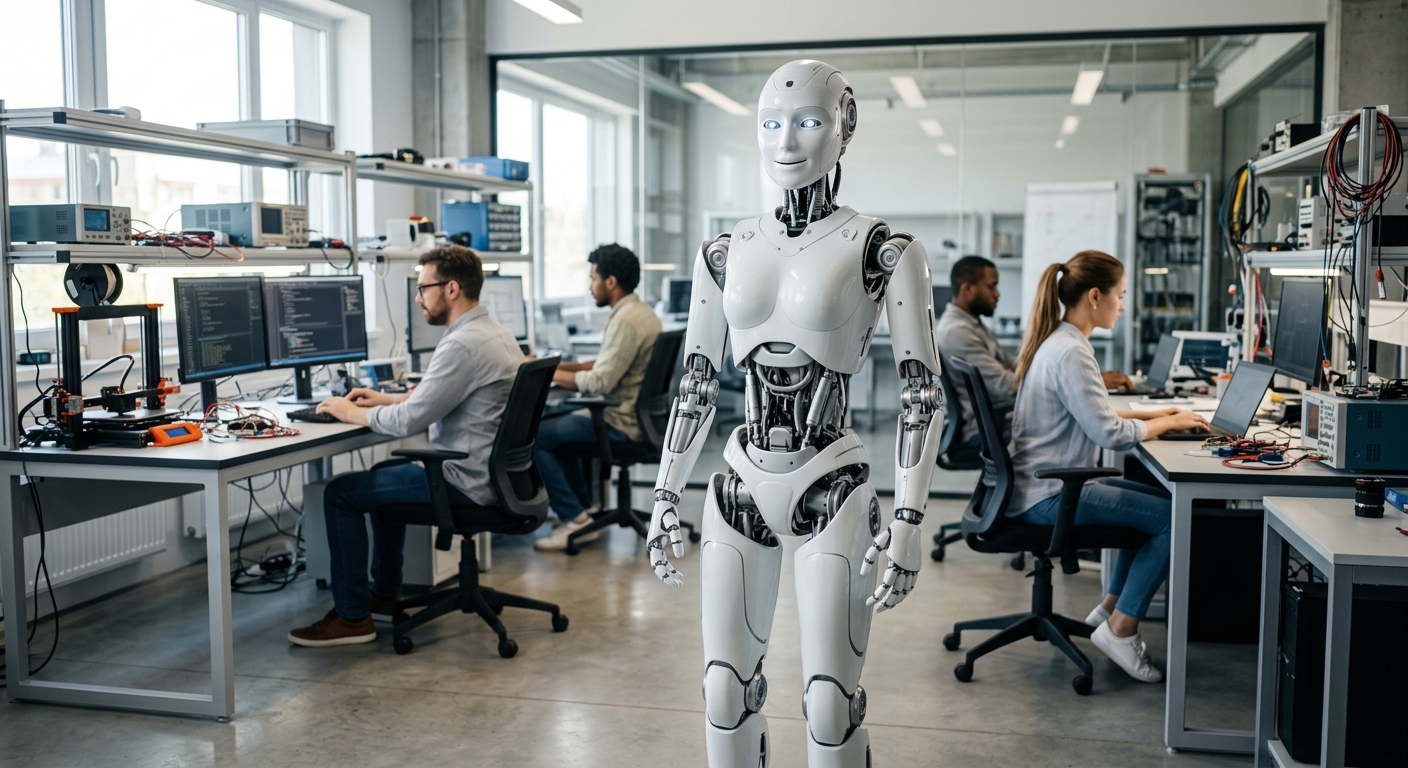
Today we are announcing the start of Emebo, an early-stage research project into a general-purpose home assistant robot. We want to be clear upfront about what this announcement is and what it is not. It is the start of a multi-year research effort. There is no product. There is no waitlist you can pay a deposit on. There will not be one for a long time. If you are looking for a robot you can put in your kitchen next quarter, this is not that.
What it is: a long-term bet that general-purpose robotics, meaning a robot that can do many things in an unstructured home environment rather than one thing in a structured factory, is becoming tractable. We think the combination of cheaper hardware, improved vision models, and agent infrastructure that can plan over long horizons has moved this problem from "clearly impossible" to "worth a serious research attempt." The word serious is doing a lot of work there. We mean multiple years, a dedicated team, and no expectation of early commercial return.
Why us. Nobody at Hasna has a robotics PhD. We are a software team with a specific set of skills: building agent systems that can plan, execute, and recover in the real world. What we have learned from building those systems for digital tasks — browsing, coding, scheduling, communicating — transfers more directly to physical tasks than we expected. The robot-specific parts (actuation, perception, manipulation) are hard but are not mysterious. There is a lot of existing academic work to build on, and the hardware side of the industry has matured rapidly. Our bet is that the missing piece — the thing that will decide which generation of home robots actually works — is the agent layer on top, which is what we already know how to build.
What the research will focus on initially. Three things. First, the task representation — how do you describe a household task like "fold the laundry" or "clean up after dinner" in a way that a robot can reason about? That sounds simple and is not. The instructions need to be robust to the kind of environmental variation that a human takes for granted and a robot does not. Second, the planning loop — given a task, how does the robot decompose it into executable sub-steps, and how does it recover when something goes wrong? Third, the safety envelope — what can a robot in a home be allowed to do, under what conditions, with what oversight? This is an area where getting it right matters more than getting it fast.
What the research will not focus on, at least in the early phases. We are not building hardware. We will use off-the-shelf robotic platforms for experiments — the academic community has converged on a small set of them, and they are good enough. We are not training novel vision or manipulation models from scratch. Where existing open-source or academic models are adequate, we use them. Our contribution, if any, is in the agent layer, which is the part we have comparative advantage in.
What you can expect to see from us. Research notes on the research page. Occasional open-source releases as we build reusable components. Honest updates about what worked and what did not. We are not going to pretend this is further along than it is. If a year from now we have demos of a robot folding a shirt, we will show you the demo and the fifty failure cases that came before it.
What you will not see from us. Sleek product videos of an imaginary robot. Pre-sales. Kickstarter campaigns. Hype cycles driven by capabilities we do not have. The robotics space is cluttered with those already. We do not want to add to it.
Why announce this at all, if the product is years away? Two reasons. First, this is a small team and a very long research horizon. We want to talk publicly about what we are working on, partly for the same reason academic labs publish — to invite feedback and criticism from people who know more than we do about parts of the problem. Second, we want to be on record now about what we are attempting, so that if we fail in two years, we can write honestly about why. If we succeed, the same.
How you can help, if you want to. Three concrete things. If you have relevant expertise — robotics, motor control, manipulation, home safety, aging-in-place — and want to consult or collaborate, [email protected] goes to a real person. If you want to follow along, subscribe to the research updates on the research page. If you are a student working on related problems and want a potential thesis topic, we have a list, and we would rather see students publish good work than sit on problems we do not have time to attack ourselves.
A note on the name. Emebo started as an internal placeholder and ended up sticking. It does not mean anything in particular. We may rename the project if we get closer to something shippable, or we may not. It does not seem important.
A note on timelines. We are explicitly not giving any. "A few years" is the most precise thing we are willing to say. The robotics industry has a long and unhappy history of making timeline commitments that do not age well. We would rather be boring and honest than exciting and wrong.
That is the announcement. Nothing to buy, nothing to sign up for, just a research project getting started. We will post the first substantive research update in a couple of months.